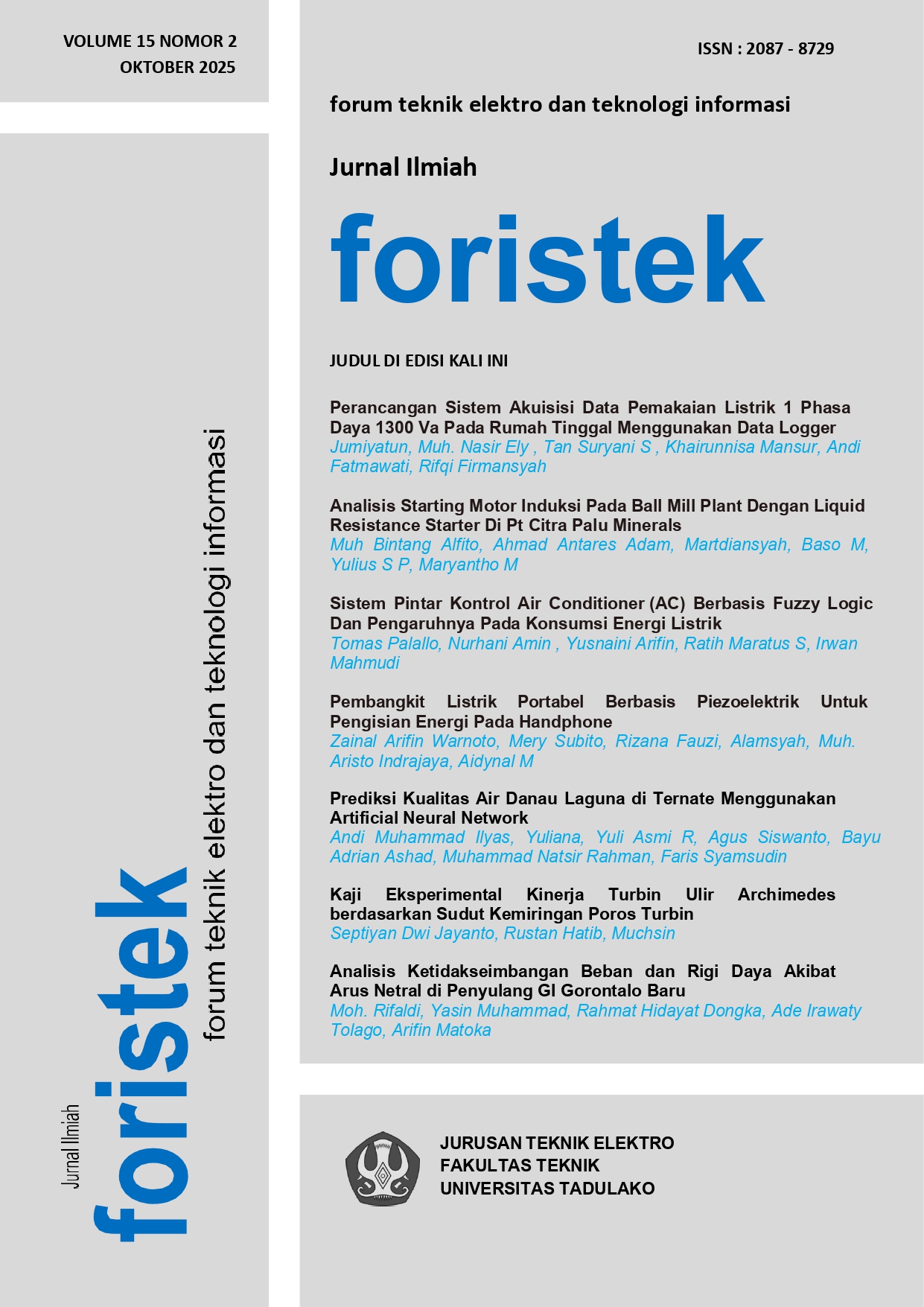
PREDICTION OF LAGUNA LAKE WATER QUALITY IN TERNATE USING ARTIFICIAL NEURAL NETWORK
DOI:
https://doi.org/10.54757/fs.v15i2.821Keywords:
Prediction, Water Quality, Laguna Lake, ANN, MLR, RF, SVRAbstract
Predicting the water quality of Laguna Lake in Ternate City is crucial to support ecosystem management and the needs of surrounding communities. This study aims to predict the parameters pH, temperature, nitrate, and phosphate for the year 2026 using four methods: Multiple Linear Regression (MLR), Random Forest Regression (RF), Support Vector Regression (SVR), and Artificial Neural Network (ANN). The data used consisted of measurements from 2017, 2023, and 2024. The prediction results show differences in performance among the methods. For pH, the 2026 predictions range from 6.54 to 8.15, with RF providing the highest value and ANN the lowest. Temperature predictions range from 31.03 to 31.86 °C, nitrate from 0.0888 to 0.1140 mg/L, and phosphate from 0.0433 to 0.0752 mg/L. ANN demonstrates the best accuracy for pH, while RF performs better for temperature. These differences indicate the presence of non-linear relationships among water quality parameters that are more complex than simple linear models. The 2026 water quality predictions offer an early assessment of Laguna Lake’s condition, providing a basis for informed management planning, conservation, and water quality decision-making. The results also highlight the effectiveness of artificial intelligence methods, particularly ANN, in modeling and predicting water quality conditions in tropical aquatic ecosystems.
References
X. Liu et al., “Impact of groundwater nitrogen legacy on water quality,” Nat. Sustain., vol. 7, no. July, 2024, doi: 10.1038/s41893-024-01369-9.
Yuliana, “Analisis Kandungan Nutrien di Danau Ngade Ternate Maluku Utara,” in Prosiding Seminar Nasional dalam Rangka Dies Natalis Ke-36, 2024, pp. 237–244.
Yuliana, “Tingkat Kesuburan Danau Ngade Ternate Berdasarkan Kandungan Nitrat Dan Fosfat,” in Prosiding Seminar Nasional dalam Rangka Dies Natalis Ke-35, 2023, pp. 296–303.
X. Lang, “Analysis of power system load forecasting based on neural networks,” J. Phys. Conf. Ser., vol. 2664, no. 1, 2023, doi: 10.1088/1742-6596/2664/1/012010.
Y. Bengio, Y. Lecun, and G. Hinton, “Deep learning for AI,” Commun. ACM, vol. 64, no. 7, pp. 58–65, 2021, doi: 10.1145/3448250.
Elang Bayu Trikora, Sasongko Pramonohadi, and M. Isnaeni Bambang Setyonegoro, “Prakiraan Beban Listrik Menggunakan Metode Jaringan Saraf Tiruan dengan Data yang Terbatas,” J. Nas. Tek. Elektro dan Teknol. Inf., vol. 12, no. 3, pp. 227–232, 2023, doi: 10.22146/jnteti.v12i3.6437.
K. A. Fakhryza, E. N. Budisusila, and A. A. Nugroho, “Application of artificial neural network for peak load forecasting in 150 kV Semarang power system,” J. Electr. Syst. Inf. Technol., 2024, doi: 10.1186/s43067-024-00165-x.
B. N. Oreshkin, G. Dudek, P. Pełka, and E. Turkina, “N-BEATS neural network for mid-term electricity load forecasting,” Appl. Energy, vol. 293, pp. 1–33, 2021, doi: 10.1016/j.apenergy.2021.116918.
T. H. Ali, “Proposed Hybrid Method for Wavelet Shrinkage with Robust Multiple Linear Regression Model 2 : Theoretical part,” QALAAI ZANISTSCIENTIFIC J., vol. 6566, no. 7, 2022, doi: 10.25212/lfu.qzj.7.1.36.
M. S. Khrisat and Z. A. Alqadi, “Solving multiple linear regression problem using artificial neural network,” IJECE, vol. 12, no. 1, pp. 770–775, 2022, doi: 10.11591/ijece.v12i1.pp770-775.
James, “An Introduction to Statistical Learning, Springer Texts in Statistics,” Springer Nat. Switz. AG, 2023.
M. López, “Multivariate Statistical Machine Learning Methods for Genomic Prediction,” Springer, 2022.
J. M. · D. X. · H. G. · Y. W. · X. N. · Z. L. · S. Jiang, “Metaheuristic‑based support vector regression for landslide displacement prediction: a comparative study,” Tech. Note.
B. Bargam, A. Boudhar, C. Kinnard, H. Bouamri, and K. Nifa, “Evaluation of the support vector regression ( SVR ) and the random forest ( RF ) models accuracy for streamflow prediction under a data ‑ scarce basin in Morocco,” Discov. Appl. Sci., 2024, doi: 10.1007/s42452-024-05994-z.
W. Fang, K. Ren, T. Liu, J. Shang, S. Jia, and X. Jiang, “An evaluation of random forest based input variable selection methods for one month ahead streamflow forecasting,” Sci. Reposrt, pp. 1–12, 2024.
Yuliana, “The best incubation time for primary productivity of phytoplankton in,” BIODIVERSITAS, vol. 19, no. 3, pp. 1021–1028, 2018, doi: 10.13057/biodiv/d190334.
Downloads
Published
How to Cite
Issue
Section
License
Copyright (c) 2026 And Muhammad Ilyas

This work is licensed under a Creative Commons Attribution 4.0 International License.






 This work is licensed under a