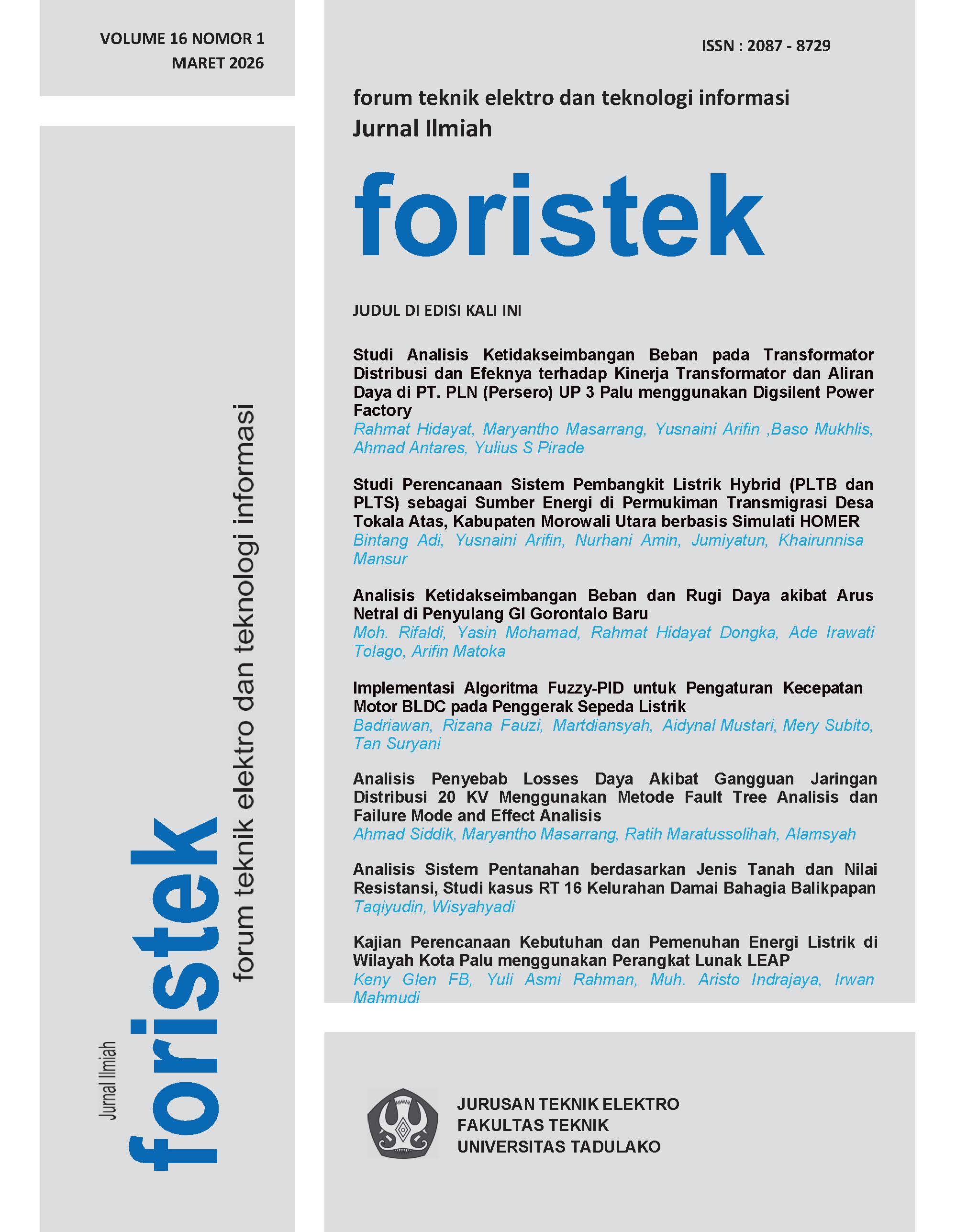
ANALISIS PENYEBAB LOSSES DAYA AKIBAT GANGGUAN JARINGAN DISTRIBUSI 20 KV MENGGUNAKAN METODE FAULT TREE ANALYSIS DAN FAILURE MODE AND EFFECT ANALYSIS
DOI:
https://doi.org/10.54757/fs.v16i1.938Keywords:
power losses, 20 kV distribution network, Fault Tree Analysis, Failure Mode and Effect Analysis, ETAPAbstract
Disturbances in 20 kV medium-voltage distribution networks have a significant impact on increasing power losses and reducing system reliability. This study aims to identify and analyze the causes of power losses resulting from distribution network disturbances by applying Fault Tree Analysis (FTA) and Failure Mode and Effect Analysis (FMEA), supported by simulations using ETAP software. The FTA method is employed to determine the root causes of disturbances through cause–effect relationships within the distribution system, while FMEA is used to evaluate the risk level of each failure mode by calculating the Risk Priority Number (RPN). Furthermore, ETAP simulations are conducted to assess active and reactive power losses as well as voltage profiles before and after technical improvements are implemented. The analysis results indicate that power losses are caused by several factors, including insulator damage, conductor or power cable failures, cable joint defects, distribution transformer issues, environmental disturbances, and protection equipment failures such as fuses and reclosers. Based on the RPN values, components with the highest risk levels are prioritized for corrective actions. ETAP simulation results demonstrate that transformer tap adjustment, conductor cross-section replacement, and capacitor bank installation effectively reduce power losses and improve voltage quality. This study is expected to serve as a reference for enhancing the efficiency and reliability of power distribution systems.
References
. Ardian Burhandono, & Sinaga, N. (2022). Menjaga Keandalan Sistem PLTS dengan Metode Failure Mode Effect Analysis (FMEA). Jurnal Teknik Industri, 12(1), 30–39. https://doi.org/10.25105/jti.v12i1.13958
. Arifin, A. (2020). Materi Lengkap Jaringan Distribusi Tenaga Listrik. https://www.carailmu.com/2020/05/jaringan-distribusi-tenaga-listrik.html
. Ariyanti, R. F. (2019). Identifikasi Penyebab Susut Energi Listrik PT PLN (Persero) Area Semarang Menggunakan Metode Failure Mode & Effect Analysis (FMEA). Industrial Engineering Online Journal, 8(1), 1–8. https://ejournal3.undip.ac.id/index.php/ieoj/article/view/23259
. Aryanto, N., & Balkis, M. (2021). Tinjauan Gangguan Jaringan Distribusi 20 Kv. JTERAF (Jurnal Teknik Elektro Raflesia), I(1).
. Kawihing, A. P., Tuegeh, M., Patras, L. S., & Pakiding, M. (2019). Pemerataan Beban Transformator Pada Saluran Distribusi Sekunder. E-Journal Teknik Elektro Dan Komputer, 1–9.
. Nelwan, M., Tuegeh, M., & Lisi, F. (2020). Penyusutan Energi Listrik Pada Penyulang SU2 Jaringan Distribusi Minahasa Utara. E-Jurnal Teknik Elektro Dan Komputer, 4(2), 67–76.
. Purwansyah, H., & Marfuah, U. (2022). Analisis Permasalahan Produk Panel Pada Komponen Wiring Dengan Menggunakan Metode Fault Tree Analysis (Studi Kasus : Pt Duta Listrik Graha Prima). November 2022, 1–9.
. Soedjarwanto, N., Kines, K. E., & Aulia, S. A. (2024). Analisis Susut Daya (Losses) Pada Penyulang Rayap Pt Pln (Persero) Uid Lampung Berbasis Aplikasi Etap 19.0.1. Jurnal Informatika Dan Teknik Elektro Terapan, 12(2), 956–962. https://doi.org/10.23960/jitet.v12i2.4072
. Susilo, D. T. J., Dewi, R., Suprapto, E., & Djufri, S. U. (2020). ANALISIS PENYEBAB GANGGUAN JARINGAN PADA DISTRIBUSI LISTRIK MENGGUNAKAN METODE FAULT TREE ANALYSIS DI PT. PLN (PERSERO) RAYON DAYA MAKASSAR. Vertex Elektro, 6(2), 23. https://doi.org/10.33087/jepca.v6i2.106
Downloads
Published
How to Cite
Issue
Section
License
Copyright (c) 2026 Ahmad Sidik, Maryanto Masarrang, Ratih Mar'atus Sholihah, Alamsyah Alamsyah

This work is licensed under a Creative Commons Attribution 4.0 International License.






 This work is licensed under a